
Ram Family Fund Expands UVA’s Global Health Impact in India
Anil K. Ram
August 10, 2025
Example H2 heading
In Pondicherry clinics and New Delhi policy offices, UVA students and researchers spent summer 2025 working alongside Indian partners to confront one of the world’s deadliest infectious diseases: tuberculosis.
Since 2014, The Ram Family Fund, an award generously established by Dr. Anil K. Ram in honor of Drs. Bellamane M. Ram and Anjan Kumari Ram, who practiced medicine in India and the U.S., has allowed UVA students from any school to travel to Southern India to participate in research collaborations or clinical care in the region. In 2024, additional funds were received to grow the interdisciplinary reach of faculty across Grounds. This summer, the Fund sent three UVA affiliates to travel to India for work related to tuberculosis.
Tuberculosis is an infectious disease caused by the bacteria Mycobacterium tuberculosis. It usually affects the lungs, but it can also affect other parts of the body. Tuberculosis is less prevalent today in the U.S. and Europe than it was in the early 20th century because of early screening, good nutrition, vaccinations, and antibiotic treatment, but it is still a massive global issue. In non-pandemic periods, tuberculosis is the leading killer worldwide from a curable infectious disease. India is one of the worst affected countries with over 320,000 deaths from tuberculosis in 2023, according to the World Health Organization.
Dr. Scott Heysell, director of the Center for Global Health Equity at UVA, specializes in tuberculosis research and treatment and has helped support the evolution of these interdisciplinary clinical and research trips, many of which have been to the city of Pondicherry, or Puducherry, in Southern India. “We’re so grateful for the partnership in Pondicherry and for the Ram funds, which have historically allowed us to foster UVA students’ interests in improving health in India and now we can involve an increasing number of faculty from across Grounds with really complimentary expertise,” he said.
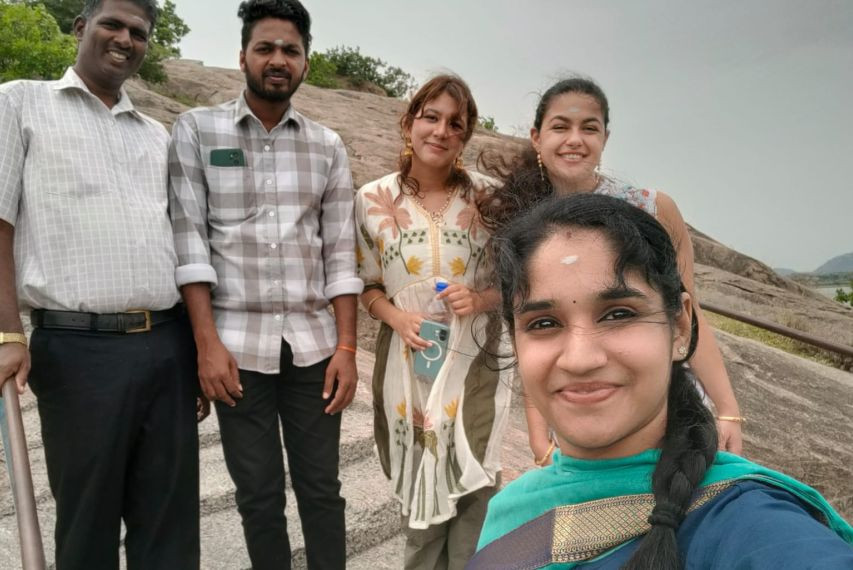
Alessandra Dutra and Rabina Bhandari, both second-year medical students, spent a month in Pondicherry, where they worked on projects related to the relationship between tuberculosis and malnutrition. Malnutrition, including adult undernutrition and diabetes mellitus, is the most important driver of tuberculosis globally. Building off of previous work done through UVA and partner institute the Jawaharlal Institute of Postgraduate Medical Education and Research (JIPMER), the pair focused on increasing community acceptability for tuberculosis screening tests among malnourished populations. They performed data analysis and attended in-person clinical visits, along with physicians and public health scientists leading the project from JIPMER.
Example H3 heading
During the first part of their medical studies in the U.S., students don’t often have the chance to interact with patients, so this clinical experience was invaluable. “This experience reminded us why all of our work matters so much, because patient care goes beyond knowing the science,” said Dutra. “It’s about treating patients as people first, not just their disease states.” She explained that it further emphasized to her the importance of identifying and prioritizing the patient’s own goals, not just profiles of ideal treatment programs. “Patients want us to know them and to care about them first and doing that is how we can create successful patient outcomes.”
The JIPMER team demonstrated this with their personal approach, which emphasized that the patients are people first. At a community advisory meeting the students attended, one patient said that visits from JIPMER felt like visits from a long-term friend. The JIPMER team accommodated patient needs, even changing the location of a home visit at the last minute and instead meeting the patient at a local hospital where the patient was waiting for an appointment.
“We might not always have a perfect solution,” said Bhandari, “but we can still use what we have to make patients feel heard, respected, and empowered. Sometimes this is better than a perfect solution.”
The two students came out as different people than when they went in. “This experience taught us a lot of humility,” said Bhandari. It also expanded their cultural knowledge and horizons. Bhandari already had some exposure to some similar cultural norms growing up in Nepal. Dutra, in contrast, found that though her family is from Brazil, her experiences growing up in the U.S. were more different. Bhandari often caught on to expectations quicker and translated them to Dutra. “We’re grateful we got to experience this together,” reported Dutra. “I think it helped us each get the most out of the time there.”
In addition to the clinical trips, Heysell and CGHE would like to increase the interdisciplinarity of the UVA research being done in India and globally. In addition to presenting new creative solutions, “an interdisciplinary approach to solving a model problem like tuberculosis will lead to methodology and solutions that can be applied to other new grants at UVA and subsequently new research opportunities for our students,” said Heysell. With this in mind, in 2024, CGHE was pleased to receive a project proposal from a PhD student working with professor Venkat Lakshmi in the School of Engineering. The applicant, who had previously led a CGHE-supported project and served on the organization’s student advisory board, was a natural fit for the Ram award, which funded his research trip in summer 2025.